A Home That Works for Busy Brains
For a long time, the idea of a perfectly clean house filled me with shame, anxiety, and pressure.
I grew up in a household where cleanliness mattered. There were right ways to load the dishwasher, right ways to fix things, right ways to keep a home running. In many ways, that structure was healthy for my brain — but there was also an unspoken tension underneath it. At the time, I didn’t know I was neurodivergent. I just knew that keeping up felt hard.
I loved organization, but my reality didn’t always match the standard. Clothes would end up on the floor because I couldn’t tolerate wearing the same outfit all day. Cups would collect in my room because I forgot to bring them back. Piles appeared faster than I could deal with them. I carried a constant anxiety that I was failing at something everyone else seemed to manage with ease.
That feeling followed me into adulthood. In my first marriage, my messiness was often met with shame. I internalized the belief that I was the problem — that I just needed to try harder, be more disciplined, be more “normal.”
Everything shifted when I moved out on my own during my separation.
For the first time, I had the freedom to explore what I actually needed from a home — without commentary, influence, or judgment. Around the same time, I learned that I was neurodivergent. And that realization brought a surprising amount of relief.
I wasn’t messy.
I just didn’t have systems that worked for my brain.

Once I started paying attention to my patterns instead of fighting them, everything changed. I noticed how clutter affected me — not in an abstract way, but viscerally. On busy days, visual clutter didn’t fade into the background. It pulled at my attention, stole my focus, and sometimes made me feel absorbed by the room itself. If I ignored it for too long, it became overwhelming. My mood shifted. My body felt tense. Thinking felt harder.
When my space was reset — even imperfectly — the difference was immediate. The room felt lighter. I could breathe more easily. I could move through my day without constantly scanning for lost items or unfinished tasks. Things lived in the same places, which meant my brain didn’t have to work as hard. I could operate on autopilot instead of staying in a constant state of alertness.
Living alone allowed me to design a home that worked with my brain instead of against it. Having a washer and dryer in my apartment was a game changer. Dirty clothes went straight into the washer. Clothes worn briefly — because of sensory sensitivities — had their own place. The floor stayed clear. My brain stayed calmer.
I grouped items based on how I actually lived, not where they were “supposed” to go. Sunscreen, mosquito spray, bear spray, lip balm, and hand sanitizer lived near the door, not in the bathroom. I bought backups and kept essentials in the car, knowing that forgetting wasn’t a moral failure — it was just a pattern. Instead of forcing habits that didn’t stick, I designed systems that reduced friction.
Then I shared space again.
Combining two homes meant combining two brains — both particular in their own ways. We work different schedules. We have different habits. Mess, routines, expectations, and mental load all became shared learning curves.
One small example still makes me smile: socks.
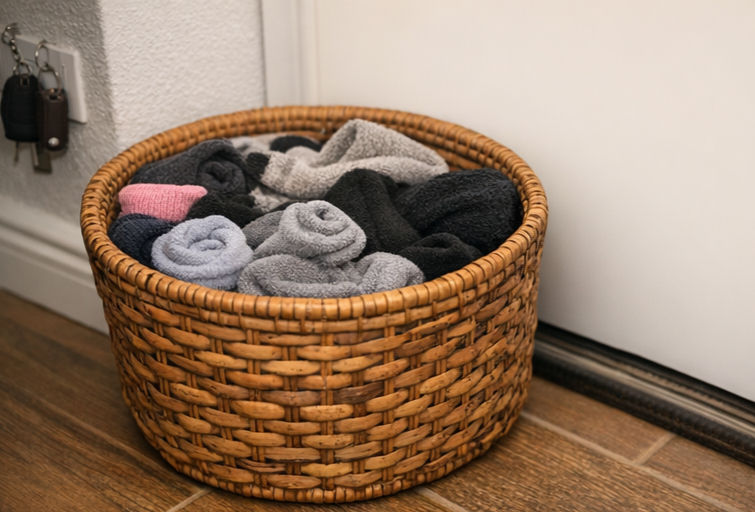
My husband used to leave his socks near the front door so he wouldn’t bring the smell into the bedroom hamper. I hated seeing — and sometimes smelling — random sock piles. Instead of shaming each other, we talked about what we were each trying to solve.
The solution ended up being simple: a small lidded bin by the door.
Socks go in. No smell. No visual clutter. No resentment.
That moment set the tone for how we build our home together. Function over appearance. Support over perfection.
The phrase that truly changed everything came from my husband on a particularly hard day. I had recently lost my job. My anxiety was high. I was trying to study for a certificate and felt like I couldn’t breathe because so many things felt misplaced. I was spiraling.
He looked at me and said, “A home is meant to be lived in.”
Not messy. Not gross. Clean — but lived in.
That reframe softened something in me. We stopped chasing picture-perfect standards and started designing a home that actually supported us. We became more compassionate with ourselves. We stopped trying to fit into what a home should look like and focused on how it needed to function.

Some of our systems wouldn’t make sense to everyone — and that’s okay. I have a ‘doom drawer’ in the bedroom for clothes that aren’t dirty but aren’t clean. The drawer closes, the floor stays clear, and my brain feels calmer.
We have a sock bucket by the front door.
Our fridge is organized so ready-to-eat foods are always visible, because if we
can’t see it, we forget it exists. We use low, warm lighting because overhead lights overwhelm my nervous system. These choices aren’t about aesthetics — they’re about accessibility.
Decluttering, for us, isn’t a seasonal ritual or a productivity hack. It’s a mental health practice. We let go of things that don’t serve us anymore — impulse buys, single-use gadgets, items that quietly create more work than value. Fewer things mean fewer decisions. Less to organize. More room to breathe.
One of the biggest shifts I made was letting go of the need to explain myself. I no longer justify why things are where they are when people visit. I don’t chase status furniture or brand-name aesthetics. I thrift. I reuse. My favourite loveseat is a recycled bamboo piece with older cushions — and I love it.
This is our sanctuary.
If someone is welcomed into it, judgment doesn’t belong here.

If you’re a woman with ADHD reading this while carrying shame about your home, I want you to know this:
A functional home isn’t about being clean.
It’s about feeling calm. Being able to move through your day without constantly worrying about what you forgot. Living in a space designed for how your brain works.
Homes are meant to be lived in — not performed.
And you’re allowed to build one that supports you.



Comments