Living in Morocco: What 45 Days Taught Me About Simplicity, Community, and Presence
Updated: Feb 8
This trip to Morocco wasn’t only about being with family—though that was the heart of it. It was also tied to work we had been building slowly and intentionally together.
Our business, The Argan Springs, is rooted in Morocco. It exists because of women-led cooperatives who produce argan oil through generations of knowledge, care, and community. Going to Morocco meant returning to family and returning to the source of work deeply connected to our values.
There was never a clean line between the two.
And that, I came to understand, was part of the lesson.

When Life Quietly Makes Space living in Morocco
I didn’t go to Morocco this summer looking for answers.
What I knew—without being able to fully articulate it yet—was that life had quietly asked me to pause.
Not in a dramatic way.
No single moment that shattered everything.
Just a soft loosening of routines. A widening of space. A realization that I had been holding my life together very tightly.
So when my husband and I decided to extend our stay to 45 days, it wasn’t part of a master plan. It was simply possible. And for the first time in a long time, I allowed myself to step into something without needing it to do anything for me.
This wasn’t my first time in Morocco. But it was the first time I wasn’t just visiting.

Entering a Different Rhythm
There is a difference between arriving somewhere and settling into it.
This time, I wasn’t nervous. I knew the heat, the pace, the customs. I trusted the family I was walking into. That familiarity gave me something I hadn’t expected—availability. I wasn’t bracing myself or watching how I showed up. I could take things in.
Days began simply.
Early morning walks to the bakery with my husband. Tables set with olive oil, honey, black olives, and bread still warm from the oven.
Moroccan mint tea was prepared the same way each time—carefully, deliberately—and offered with every meal. Its rhythm quietly marked the day, anchoring moments of pause, conversation, and togetherness.
Breakfast wasn’t an event. It was a rhythm.
So was lunch. So was tea. So was dinner that arrived later than my body clock expected and stayed longer than my old habits would have allowed.
Food in Morocco isn’t just nourishment. It’s how people gather.
Meals are shared—always. One dish. One table. Bread passed back and forth. You eat what’s in front of you. If the best piece lands elsewhere, it simply wasn’t meant for you that day.
There is something deeply grounding about living with only what you need—and sharing the rest.
No rushing. No optimizing.
No separating life into neat, efficient parts.
Just together.
Belonging Without Language

Marrying into a family that doesn’t share your first language teaches you something quickly: connection doesn’t depend on fluency.
At first, I stayed near the edges. A book in my hands. Drawing with the kids. Observing conversations I couldn’t fully follow. My husband was catching up with siblings he hadn’t all been together with in years, and I wanted to give space without disappearing.
But no one let me disappear.
Someone always translated the joke halfway through. Someone always pulled me in. Curiosity moved both directions.
Presence did most of the work words couldn’t.
One afternoon, my mother-in-law sat peeling peas for dinner. Without thinking, I sat beside her and started helping. We didn’t say much. We didn’t need to. The quiet felt connective, not awkward.
Another day, my brother-in-law tried to explain a sore on his toes and called them “the fingers of the feet.” Foot fingers. We laughed until it hurt.
It still makes me smile.

These moments—imperfect, human, unpolished—became treasures.
Evening walks together. Browsing the souk. Sharing photos. Acting things out when language fell short. Touch, laughter, patience, effort on all sides.
Belonging didn’t arrive through explanation.
It arrived through showing up.
The Culture as Teacher
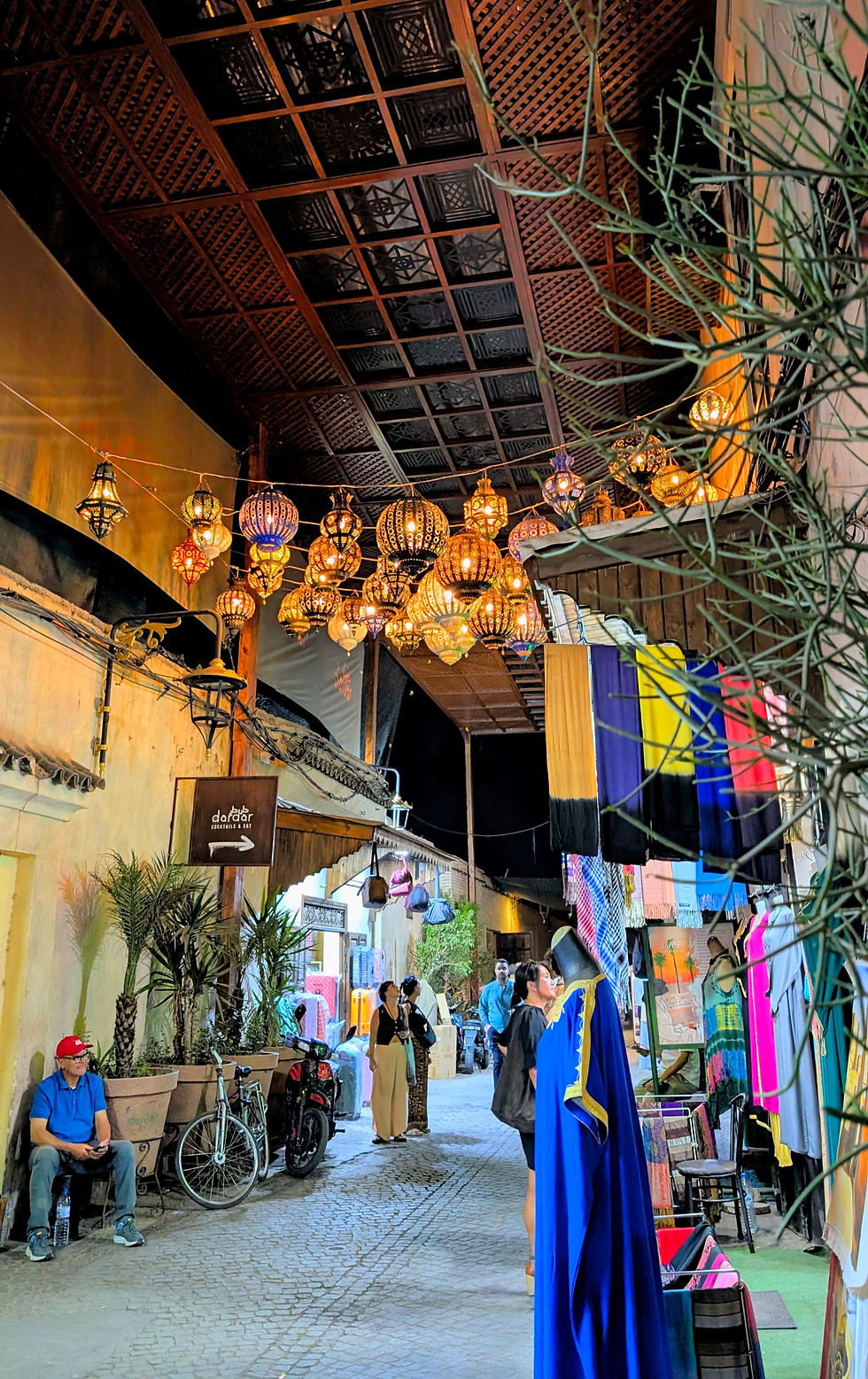
Moroccan culture doesn't rush you.
It asks your body to slow down before your mind catches up.
Family is central. Meals are anchors. Time is protected. People travel hours just to spend a weekend together. Work exists, but it doesn’t override life. Care for elders, children, and community isn’t something you fit in—it’s something life is organized around.
What struck me most was how much this culture asks you to be open.
Open to difference.
Open to discomfort.
Open to learning without comparison or correction.
To truly experience Morocco, you have to release the need to do things “your way.” You have to allow your body and perspective to be shaped by someone else’s rhythm.
That isn’t passive.
It’s a choice.
And once you make it, the world opens differently.
Living Simply, Living Together
One of the most profound shifts for me came from how simple life is allowed to be.

In Morocco, life isn’t organized around status or accumulation. It isn’t about what you own, what you drive, or how much you’ve acquired. What matters is who you belong to, who you show up for, and how present you are when you’re together.
There is a deep understanding of enough.
Groceries aren’t stockpiled. You buy for the next few days, not the next few weeks.
Meat is purchased the day you plan to cook it—walked home from the local butcher, freshly cut or ground right in front of you.
Chickens are prepared that day. Fish is chosen from what was caught most recently. Vegetables come from nearby stands, vibrant and imperfect.
Food is fresh because life is local.

You walk.
You greet people.
You pause.
Life happens between destinations.
Hospitality follows the same principle.
In Moroccan culture, generosity isn’t about excess—it’s about sharing what you have abundance of. Bread is offered easily. Tea is poured without hesitation. If there is extra, it is given—to children passing by, to families in need, to neighbors—without question or performance.
Giving isn’t a gesture. It’s a reflex.
There is dignity in this simplicity. A quiet richness that doesn’t announce itself. Wealth isn’t measured by things, but by connection—by how many people sit at your table, by how often your door is open, by whether you are known in your community.
Living this way shifts something in you.
You stop chasing.
You stop comparing.
You start noticing.
You realize how little you actually need to feel full—and how much presence has been missing.
Learning Through Watching

Being in Morocco also meant visiting the women-led cooperatives at the heart of our work with The Argan Springs.
These weren’t factory tours or staged demonstrations. They were living spaces—places where work folds naturally into life.
The cooperatives operate with a steady openness. Doors open in the morning and close in the evening, but the work itself flexes. Women scale their time up or down depending on what their families need and what season of life they’re in. Contribution is consistent, but never forced.
Sitting shoulder to shoulder with the women, learning how to crack argan seeds and sort them by hand, I was struck by the care woven into every step. There was no rushing. No urgency for urgency’s sake. Each movement was practiced, precise, and unhurried.
What they were producing wasn’t just oil—it was quality shaped by attention.
Knowledge was shared generously. Pride showed up not in titles, but in mastery. In doing something well because it matters.
The cooperatives we work with are grounded in fairness—fair wages, shared accountability, and respect for the women’s expertise. Their work is valued not as labor to be extracted, but as skill to be honored.
Seeing this in person made something unmistakably clear:
Meaningful work can exist inside life. It doesn’t have to replace it.
And once you see that modeled so clearly, it’s hard to accept anything less.
The Women and the Softening
What stayed with me most was the women.
Women in Morocco carry life. They are caretakers, organizers, anchors. Mothers are deeply respected and supported by community. There’s a common misconception about why women cover—it isn’t about restriction. What I experienced felt protective. Intentional. Grounded.

I felt more beautiful in flowing clothes than I ever had in tight ones. Softer. More feminine. More at ease. I realized how long I had kept that part of myself closed off simply because I never gave it time to exist.
Shopping with my sisters-in-law, trying on clothes I once would have been too nervous to wear, I felt something open. Not performative femininity—but lived-in womanhood.
Work exists. Ambition exists. But they don’t erase care, softness, or presence.
Life here feels fuller because it is shared.
The Shift I Didn’t Announce
Somewhere along the way, my body changed.
I slept more deeply.
I stopped scanning rooms.
I stopped preparing explanations for who I was or what came next.
I didn’t need to perform.
I didn’t need credentials. I didn’t need a plan to justify my place at the table.
I was welcomed for my presence—for my laughter, my stories, my curiosity.
For the first time in a long time, I saw myself as a whole person—not a role, not a résumé, not a list of accomplishments.
And the weight I didn’t know I was carrying lifted.
What I Chose to Carry Home
When we left, it didn’t feel like an ending.
It felt like a continuation.
I carried home a slower internal pace. A deeper trust. A redefined sense of richness—not what you accumulate, but what you share.
There’s a word I learned how to embrace that summer: Inshallah—if God is willing.
Not resignation. Trust.
When I stopped gripping so tightly, life unfolded gently. New friendships. Unexpected collaborations. Opportunities that arrived without force.
This wasn’t just a trip.
It was a choice—to live differently, to see the world through someone else’s rhythm, to let culture teach me what productivity never could.

What I Know Now
If I could speak to the version of myself who felt tired, hunched, and unsure, I wouldn’t rush her.
I would tell her this:
You don’t need to hurry.
You don’t need to prove anything.
You are allowed to live inside the days.
Sometimes the most meaningful journeys don’t move us forward at all.
They teach us how to belong to our lives again.
Below is some of my favorites during our time living in morocco


Comments